





Eye For Film >> Movies >> Don't Be Prey (2026) Film Review


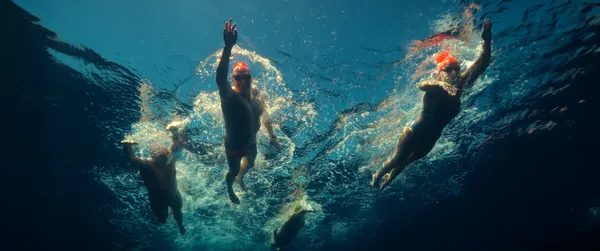

Long distance swimming is often looked at just as an athletic activity, a question of muscle and fitness and patience. Perhaps that’s true in a pool, but when it comes to swimming in the sea, there’s much more to it. “You’re putting yourself in the food bowl,” as one person puts it here. There are numerous dangers to contend with. All you can do is stay focused, listen to your coach, take nourishment when needed, keep moving and, rh, try to avoid getting eaten.
Mark Sowerby has already been swimming with sharks in the metaphorical sense, as those who recall the financial scandal of 2018 will know. In case you don’t, a good ten minutes is spent telling us about its emotional effect on him before this film gets going, Suffice to say that when he lost his reputation he also lost his confidence. To get it back, he knew he had to set himself a challenge. He already liked distance swimming. it was time, he decided, for some serious training, so he could take on the Oceans Seven challenge.

This does not, you will be pleased to hear, involve swimming in seven oceans or large seas. No matter how touch you may be, the Southern one would quickly kill you. No, this challenge instead focuses on seven channels, as follows:
- The Molokaʻi Channel (also known as the Kaiwi Channel): between Moloka’i and O’ahu, 45km/ 28mi
- The English Channel: between England and France, 33.5km/21mi
- The Catalina Channel: between Santa Catalina Island and Los Angeles, 32.3km/20mi
- The Strait of Gibraltar: between Spain and Morocco, 14.4km/9mi
- The North Channel: between Northern Ireland and Scotland, 34.5km /21.5mi
- The Cook Strait: between New Zealand’s North and South Islands, 22.5km /14mi
- The Tsugaru Strait: between the Japanese islands of Honshu and Hokkaido, 19.5km/12mi
If you know some of these areas, you may already be feeling uncomfortable. The North Channel, whose currents at times make it too dangerous to sail a modern ferry across? The Molokaʻi Channel with its man-eating tiger sharks? The Cook Strait with its great whites? When you are in the water, we’re told, “It’s just you versus whatever comes at you.”
There is a support boat, of course. A stubborn coach and a supportive wife, each with their own burden to carry. Still, its is noted, sometimes one can’t really see the swimmer from the support boat, even when close. Waves baffle the eyes. Portions of some of the swims take place by night, and Mark and the boat are illuminated by red light because predators can’t see it, but it’s not easy for humans either.
Other marathon swimmers share stories of horrific experiences. We hear about jellyfish stings and pulmonary oedema. There is a detailed explanation of the physiological effects of hypothermia, and of how, when it comes on slowly, one might start to hallucinate and not even feel cold. Then there is the financial cost, which is simply beyond the means of most people, especially as bad weather could mean it has to be cancelled with less than 24 hours’ notice. The psychological isolation seems like a danger, who struggles on his first swim when he gets into a cycle of negative intrusive thoughts. Community helps with that. People who haven’t done it will never understand what it’s like to face such strain (there are of course numerous other ways of experiencing it, which is elided here); but the community of marathon swimmers support one another.
Though at times the film feels like a puff piece, it does provide a thorough account of many of the challenges associated with the sport, and at the same time succeeds in getting across some of why people want to do it. Pit yourself against the sea and the sea will always win, but in these limited contexts, with the right support, one might pit oneself against oneself, and the sea will provide the test.
Curiously, nobody ever points out that it’s also a good idea not to drown.
Reviewed on: 20 Mar 2026


Director: Jeff Tseng
Writer: Steven Sander, Jeff Tseng
Starring: Mark Sowerby, Tim Denyer, Steven Munatones, Heidi Sowerby, Bengisu Avci, Jamie Mackay
Year: 2026
Runtime: 91 minutes
Country: Australia
Festivals:
Search database:
